
Impact-first investing
Impact investing has evolved from niche to mainstream over the past decade as investors validated the prospect of achieving market-rate returns alongside social or environmental good. Impact-first investing is returning as a critical frontier in impact-investing, emerging from the neglected middle ground between market-rate impact investing and philanthropic grants.
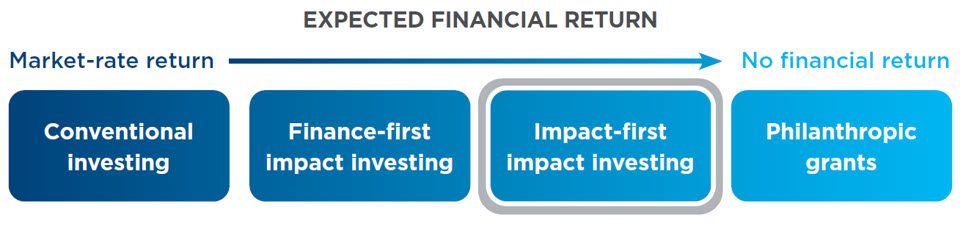
What is impact-first investing? Impact-first investing–a middle ground between market rate impact investments and philanthropic grants. This type of investing extends a financial lifeline to enterprises unattractive to conventional investors, and measures success by social and environmental benefit, not financial return.
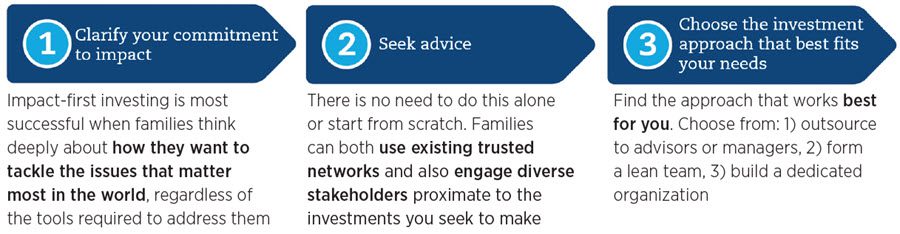
Impact-first impact investing, also called “catalytic capital,” is well-suited for investors “who want to support enterprises or funds that have high-impact potential but struggle to raise suitable financing because they are too early-stage or otherwise risky, expect to generate only modest returns, or require a longer investment time horizon,” as explained the Catalytic Capital Consortium, a leading advocate (see Bridgespan’s full report here).
Case Studies
The Kresge Foundation works to expand opportunities in America’s cities through grantmaking and social investment. It seeks to influence the quality of life for urban populations today by investing in organizations that work in health, the environment, community development (particularly in Detroit, Memphis and New Orleans), arts and culture, education, and human services. Kresge uses funding methods beyond the traditional grant, including through Innovative Capital (debt) investments and guarantees. Bridgespan has supported Kresge on both their grantmaking and their social investing strategies as well as on the tactics of operationalizing and staffing these strategies.
LIIF is a national CDFI leading the industry in funding healthy communities by providing innovative capital solutions. For more than 30 years, LIIF has invested more than $2.7 billion in high social value projects that lack access to traditional financial institutions, such as affordable housing, early child care and education, and the civic infrastructure needed for thriving communities. Bridgespan helped LIIF create an Impact-Risk-Profitability (IRP) framework to enable more intentional and balanced decision-making around impact, risk, and sustainability. The IRP framework includes both an upfront assessment of impact, risk, and profitability as well as an approach to evaluating the impact of LIIF’s loans to inform future lending. An assessment of a loan’s ability to drive racial equity is at the heart of the impact tool, informed by input from some 30 experts over the course of several months.
What LIIF Has to Say About Working With Bridgespan
“Bridgespan’s team was incredibly dedicated in their work to steer LIIF toward a practical impact framework, and to help us visualize how to balance impact risk and profitability considerations to enable LIIF to carry out its strategy to lead with impact in our lending.”
Frequently Asked Questions
Getting Started
What Is Impact Investing and Why Should You Care?
Philanthropy and government funding is not enough to meet the needs.
Bridgespan Publications about Impact Investing
Our publications are prominently featured on news platforms that reach both the social sector and the for-profit sector. The breadth and depth of topics covered by our publications position us as thought leaders in the impact investing industry. For a more complete list, please visit our impact investing publications page.
Philanthropy’s New Frontier— Impact Investing
Philanthropists should become more active impact investors, focusing on building sustainable social enterprises often overlooked by private investors who seek market-rate returns.
Industries Where We Have Worked
See our industry insights that draw from our due diligence work on more than 1,200 potential impact investments across the globe.
- Consumer Goods/Retail
- Education
- Energy
- Financial Services
- Food and Agriculture
- Healthcare
- Industrials
- Technology, Media, and Telecommunications
- Transportation
Our Experts on Impact Investing

Chris Addy
Partner, Head of Market Impact Southeast Asia

Michael Etzel
Partner and Co-head of Impact Investing
Stephanie Kater
Partner and Co-head of Impact Investing