
Family offices are uniquely positioned to use their financial know-how to pursue impact-first investing*, which measures success in terms of achieving the change they want to see in the world. Yet many remain uncertain, if not skeptical, about the potential of the impact-first approach from both financial and impact perspectives. As a result, most family offices manage their assets through conventional investing and use philanthropy to anchor their change agenda.
Even so, a number of family offices have come to recognize the limits of channeling philanthropy to the issues they care deeply about, such as education, health care, or the environment. Grants only take nonprofits so far. By contrast, impact-first investing dovetails with philanthropic aspirations and values and delivers an investment return that can be reused—recycled—for impact-focused purposes.
Advocates see a role for the impact-first approach alongside both grantmaking, which typically seeks no return of grant dollars, and conventional investing, which seeks to maximize financial returns. (See Figure 1.) The impact-first approach adapts conventional investing terms to the needs and context of the problem at hand. It might include lengthening investment time horizons, lowering the cost of loans, increasing risk tolerance, or adopting blended finance structures involving multiple players with different risk-adjusted return expectations. Even so, impact-first investment can still deliver attractive financial returns while steadfastly working to generate beneficial, measurable social change in the messy middle where grants and conventional investing don’t work.
Skeptics of the impact-first approach worry that those adaptations—which some dismiss as “concessionary”—amount to bad investments. After all, they argue, if they grow their wealth the old-fashioned way, they can write bigger grant checks in the future. Wouldn’t they have more impact if they maximized their investment returns to fund that grantmaking? Indeed, those return-maximizing investments could themselves be in social enterprises—making them “finance-first” impact investments with no concessionary terms.
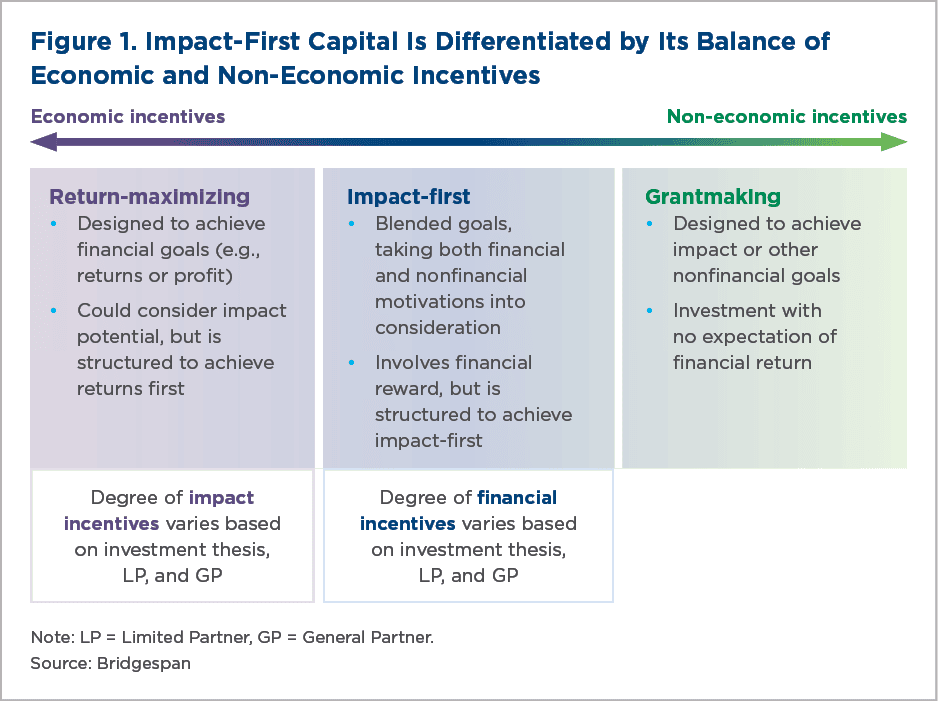
Admittedly, impact-first investing won’t appeal to those whose primary goal is to grow their wealth as much as possible. But we’ve worked with many high-net-worth individuals and families over the past 25 years who are doing significant philanthropic work and increasingly wondering whether they could do more with their capital.
The idea of putting investment capital to work specifically for social change belongs to an emerging field that, over the past 20 years, has adopted a variety of forms and labels, including impact investing, catalytic capital, blended capital, and impact-optimizing investment. Pioneers in the field include Acumen, Root Capital, the Media Development Loan Fund, and community development financial institutions in the United States, which were, in turn, built on the work of many others in the field.
Despite these ideas sometimes overlapping or being similar, the impact-first approach does not benefit from decades of portfolio construction and academic research. The thin track record gives investors pause. We hear again and again questions that boil down to this: how do I know impact-first investing is worth the trade-offs compared to the simplicity and familiarity of combining return-maximizing investments with grantmaking?
That question inspired us to launch a research project to provide helpful insights to those stuck on the sidelines. We began with a simple belief: grantmaking, impact-first investing, and finance-first impact investing can each produce positive social or environmental impact when the conditions are right—and can even complement one another. We focused our research on two objectives.
First, can we identify types of investments where an impact-first orientation achieves distinctive results that either return-maximizing or grantmaking approaches could not? In these instances, what market conditions determine when impact-first investing enables impact that otherwise would not be achieved? Specifically, when does grantmaking reach the limit of its ability to help those in need? And when does a return-maximizing approach create incentives that sideline important social and environmental impacts to grow a more profitable business?
Second, do impact-first investing approaches that recycle investment returns into impact-first investments generate more impact than grants or return-maximizing investments over the same timeframe?
Making the Case for Impact-first Investing
The impact-first approach operates in the space between where philanthropic grantmaking reaches its limits of scale and where finance-first has no financial incentive, or the wrong incentives, to provide more capital. Within that space, we sought to identify specific market conditions that create fertile ground for impact-first investments. Four emerged:
- Market or intervention maturity
- Strength of economics (e.g., risk and return, market size, revenue certainty, unit economics, regulatory environment, availability of public funding or subsidies, liquidity)
- Degree of alignment between financial incentives and impact outcomes
- Amount of capital required
We found three combinations of these conditions in which impact-first investing excels:
- Sustain funding: Where a large amount of capital is required, and the underlying economics are unattractive to commercial investors.Impact-first capital fills a void in settings where philanthropic grantmaking stops, and commercial investors steer enterprises toward more-profitable and often higher-income segments of a population, leaving out lower-income households.
- Maintain impact fidelity at scale: Where market incentives prioritize returns over impact, particularly as an enterprise scales.Even with strong business models backed by evidence-based market research, mission-focused entrepreneurs can gravitate toward approaches that prioritize growth and low cost over impact. Impact-first investors can back founders committed to social and environmental outcomes and provide those enterprises with more runway to demonstrate those outcomes.
- Build new markets: Where a large amount of capital is required to bridge the financing gap between start-up and commercialization.
Some promising enterprises can expect to turn a profit when they mature, but they stall in a “valley of death” where financing the transition from proof of concept to proof of commercial viability is too expensive for grantmakers and too risky for most investors. Impact-first investors help bridge that financing gap.
We then examined six issue areas where the scenarios above apply: sustainable agriculture, affordable housing, virtual tutoring, online pediatric mental health counseling, next-generation geothermal, and employee ownership. For each, we identified actual philanthropic grants, impact-first, and finance-first examples with similar intended impact and operating in similar contexts, making them roughly comparable. We used public and proprietary data for comparative analysis, alongside interviews with practitioners and funders. After crunching the numbers, we concluded that impact-first investments can deliver distinctive impact where markets do not work and grantmaking alone cannot reach sufficient scale.
Further, unlike grantmaking, impact-first investments can put the same dollar to work multiple times. As a result, over a 10–15-year period, our analysis shows that impact-first investing in the right circumstances can deliver, on average, twice the impact of a grant or of return-maximizing investments. Additionally, one dollar of impact-first investment can recycle multiple times over 15 years, deploying $3.4 for every $1 initially invested.
We believe our quantitative analysis shows there’s room in the marketplace for more impact-first investing under the right conditions, alongside grantmaking and return-maximizing investing. We hope the examples in this report illustrate how impact-first might fit into your own philanthropic aspirations and investment goals. But most of all, we hope that the report inspires you to give it a try. There’s no substitute for learning that comes from doing.
*Impact-investing services are provided by Bridgespan Social Impact, Inc., a wholly owned subsidiary of The Bridgespan Group.